Floyi Review and Pricing 2026
- Content Scribblers Team
- SEO Tools , Reviews
- 06 May, 2026
SEO agencies, content strategists, and in-house growth teams should choose Floyi when topical authority work needs to move faster without losing brand alignment. It turns brand voice, buyer signals, and live search data into topical maps, briefs, and drafts. That reduces handoff friction across SEO, GEO, and AEO programs.
Define brand foundation and audience inputs before generating the first topical map. Review the four-level hierarchy, then check whether URL slugs, intent, and placeholders match how the site is organized. Compare the free plan, Creator, Pro, and Agency tiers against seats, credits, and monthly research volume before scaling.
After two content cycles, content leads, SEO agencies, and growth managers should review topical overlap, brief quality, and AI visibility across Google and AI surfaces. The article’s planning benchmark moves topic map work from 16 to 27 hours to about 4.5 hours. A client roadmap or multi-brand program can use the same hierarchy to cut spreadsheet churn, and the body below covers pricing, features, fit, and tradeoffs.
Floyi Review and Pricing Key Takeaways
- Floyi combines brand input, audience signals, SERP data, and AI search signals in one workflow.
- Topical maps can reach four levels with editable slugs, intent, and execution placeholders.
- Briefs connect keyword clusters, internal links, SERP competitors, and People Also Ask patterns.
- Drafting uses multi-agent passes for voice, accuracy, research, persuasion, and evidence.
- AIRS Analyzer tracks Content, Market, and AI Authority across 11 search endpoints.
- Pricing scales by credits, seats, and monthly research runs, starting with a free plan.
- Best fit is agencies and in-house teams needing topical authority planning, not technical SEO audits.
What Is Floyi?
Floyi is an AI-powered, topic-first SaaS platform for SEO and content teams that need one system for research, topical maps, briefs, drafts, and optimization across Google search and AI search. It combines artificial intelligence (AI) with a topic-first content strategy so planning starts with the brand and the audience, not a keyword dump.
Its closed-loop content workflow starts with brand identity and audience context. That input becomes a topical map, then carries through briefs, drafts, and optimization so strategy stays consistent from planning to publishing. That is the core of Floyi AI and its AI-powered content strategy.
The best fit is teams that need a defensible content plan and topical authority roadmap. We see that most clearly in:
- SEO agencies and freelance SEOs building client roadmaps
- In-house content strategists and growth teams balancing multiple priorities
- Marketing managers who need a topical authority roadmap tied to business goals
Floyi is built for 2026 search priorities too. It supports Search Engine Optimization (SEO), Generative Engine Optimization, and Answer Engine Optimization (AEO), which matters as visibility shifts across classic search results and AI-generated answers. For a deeper look at how AI search experts are approaching these shifts, see our playbook.
Operationally, Floyi consolidates research, prioritization, and content production into one platform. It is not mainly a backlink analysis tool, a crawl audit suite, or a real-time content scoring app. The value sits in topic-first planning, authority building, and competitive visibility across Google and AI surfaces, which is why it works best as an SEO platform for agencies and growth teams that want strategy and execution in one place.
What Features Does Floyi Offer?
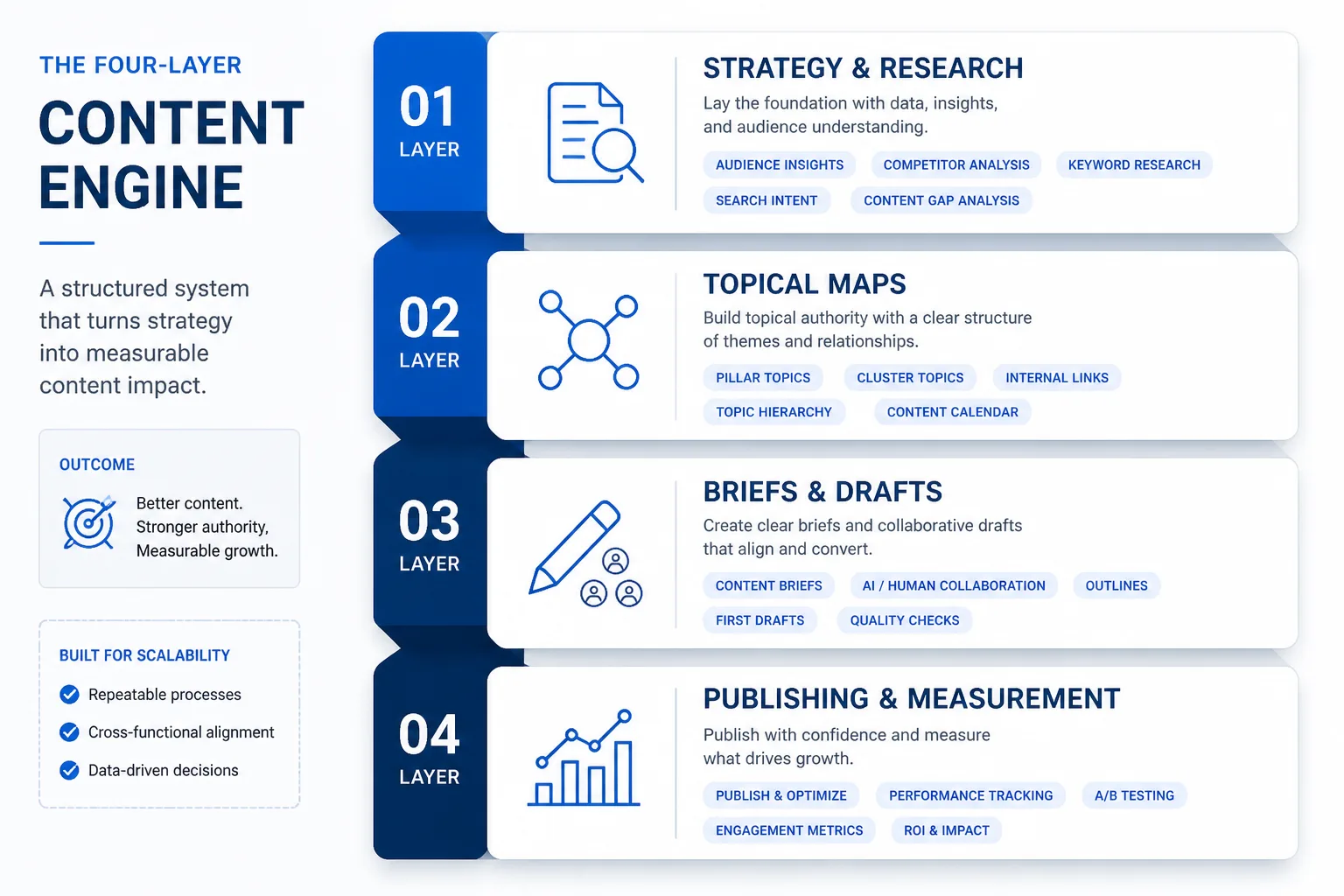
Floyi brings SEO, AI, generative engine optimization (GEO), and AEO into one closed-loop content workflow. We found that keyword research, SERP analysis, topical maps, briefs, drafting, and visibility tracking stay tied to the same plan instead of drifting across separate tools.
The feature set falls into four layers:
| Layer | What Floyi does | Why it matters |
|---|---|---|
| Strategy and research | Captures brand foundation and audience signals, then turns them into structured topical research and SERP-aware clustering | Keeps planning aligned with positioning and live search demand |
| Topical architecture | Builds topical maps with up to four levels of hierarchy, clean URL slugs, and execution-ready placeholders | Gives editors and SEO leads a usable content structure |
| Briefs and drafting | Generates multi-agent, brand-grounded AI-powered briefs and drafts content that is closer to publish-ready than rough notes | Smooths the handoff from planning to writing |
| Visibility and reporting | Tracks AI surfaces, topical authority scores, and competitive coverage | Shows where a site owns, overlaps, or trails topic demand |
Floyi’s topical maps are flexible enough to support spreadsheet-style, silo, and outline views. Teams can tune clustering tightness, edit inline, re-cluster when the topic model shifts, and import or export work through Excel, CSV, Google Sheets, XLSX, or DOCX. For a comparison of how different topical map tools and software handle these workflows, see our buyer’s guide.
The brief-to-draft path is where the platform feels most operational. Floyi uses brand context, personas, internal links, and source material to generate AI-powered briefs, then carries that context into the draft workspace. The inline Content Editor and AI Assistant act as AI writing assistants that can humanize text, simplify dense sentences, and expand ideas during drafting.
Publishing and measurement round out the stack. Floyi can push briefs and drafts to WordPress, while Rank Math and Yoast help reduce manual metadata setup. The tradeoff is that teams need solid brand inputs to get the best output. We see the system as strongest for agencies and in-house teams that want one closed-loop content workflow, not a lightweight editor.
How Does Floyi Build Topical Maps?
Floyi builds topical maps from brand and audience context first, then uses SERP analysis to turn that input into a layered hierarchy instead of a loose keyword dump. The structure begins with a main topic and expands into subtopics, intent clusters, and supporting pages, so the architecture matches how search demand is organized. The four-level depth can help multi-piece programs identify and reduce page overlap and keyword cannibalization by clarifying topic hierarchy and intent distribution.
The mapping can reach four levels, which gives content strategists enough detail to plan flagship pages and the smaller assets that support them. Floyi also folds clustering into the same workflow, so messy keyword lists become prioritized topic groups with adjustable clustering tightness before the plan leaves the tool. Agencies and in-house teams can move from research to a usable plan without bouncing between spreadsheets, clustering apps, and manual mapping. Teams looking for help with this kind of planning can also explore our guide to topical map experts.
The output is built for execution, not just review, because each topic can carry URL slugs, page intent, and content placeholders. We found that useful for both single-site planning and larger content systems, since each page keeps a clear role inside the broader architecture. Floyi’s live-SERP clustering and four-level visual maps also help different writers work from the same codified methodology, which supports consistency over time.
The three visual formats make the structure easier to review and edit:
| View | What it shows | Best use |
|---|---|---|
| Spreadsheet | Editable rows, slugs, intent, and placeholders | Cleanup and planning |
| Silo View | Pillar structure at a glance | Stakeholder review |
| Outline View | Larger branches and nested topics | Complex site architecture |
That combination makes Floyi a strong fit for teams that need topical maps they can actually publish from, not just analyze.
How Do Briefs And Drafts Work?
Floyi keeps the strategy chain intact by turning brand foundation and audience persona inputs into AI-powered briefs first, then using those same inputs to generate editable drafts. The plan, outline, and opening copy all stay tied to the same positioning.
Each brief is built for SEO execution, not generic summary text:
- Section goals define what the page has to achieve.
- Keyword clusters shape topical coverage and search intent.
- Internal link targets and anchor text guidance support on-page structure.
- Top SERP competitors and AI sources such as Google AI Overviews, AI Mode, and ChatGPT Search inform the source set.
- PAA Explorer helps surface People Also Ask patterns that deserve coverage.
Format also changes the outline automatically. Floyi detects whether the page is a how-to guide, product review, alternatives page, or comparison post, then applies the right structure. The Include My Brand toggle can add Floyi to roundup or review-style entity sets when that makes sense.
Briefs are not one-size-fits-all, either. Knowledge Base scope can be filtered in four ways:
- All documents for the broadest evidence base
- Category for a narrower thematic view
- Specific document for a tightly controlled source set
- None when the brief should stay detached from the Knowledge Base
The draft stage then moves through a multi-agent editorial pass:
- The first draft aligns to brand voice and persona fit.
- A fact checker tightens accuracy.
- A web research agent adds supporting context.
- A conversion coach strengthens persuasion.
- An evidence integrator connects claims to proof.
The multi-agent editorial pass can produce a more polished first draft and may reduce revision cycles, particularly for standard SEO articles where brand voice and structure are well-defined. Weak brand or persona inputs can still make even good AI writing assistants sound generic, and highly technical niches usually need manual tuning for tone, claims, and depth before publication.
What Does The AIRS Analyzer Measure?
AIRS Analyzer measures AI Authority and AI search visibility first, not just classic keyword rankings. In Floyi, that means we can see where a brand appears in answers, summaries, and citations across AI surfaces as well as Google and Bing SERPs. The output sits inside topical authority mapping, where Topical Authority rolls up through a 3-Pillar Audit. For more on how topical authority experts approach this kind of measurement, see our hiring guide.
The scorecard combines three signals:
- Content Authority measures coverage, subtopic structure, and shipped page performance.
- Market Authority measures visibility share against competitors.
- AI Authority measures mentions and citations across AI search systems.
That mix feeds the Topical Authority Score and gives teams one view instead of disconnected reports. The AIRS Analyzer also surfaces raw results, query fan-out, entity analysis, comparison tables, and strategic reports, which shows which sources and domains win a topic.
It tracks these AI endpoints and baseline search surfaces:
- Google AI Overviews
- Google AI Mode
- ChatGPT Search
- Perplexity
- Bing Copilot
- Claude Web
- Gemini Grounding
- OpenAI Web
- Google SERPs
- Bing SERPs
That data changes content priorities fast. A thin pillar, weak market share, or missing AI citation should move up the roadmap. A strong silo can be protected while effort shifts to gaps competitors are filling faster.
Delta indicators and investment-priority ranking add the decision layer. They show what changed since the last run and point to the next brief, draft, or update first.
How Much Does Floyi Cost?
We price Floyi as a professional SEO and AI workflow platform, so the right plan depends on seats, credits, and monthly topical work volume. The free plan is enough for a trial. It includes 500 credits, one seat, core features, and no credit card requirement.
| Plan | Monthly price | What it includes |
|---|---|---|
| Free | $0 | 500 credits, 1 seat, core features |
| Creator | $49 | 5,000 credits, 100 Knowledge Base docs, 3 monthly topical research runs |
| Pro | $99 | 15,000 credits, 3 seats, 500 docs, 5 runs |
| Agency | $229 | 50,000 credits, 8 seats, 2,000 docs, 15 runs |
Credits set the real ceiling on usage. Brand Foundation, buyer persona generation, SERP-based keyword clustering, and topical map hierarchy all consume credits. Monthly credits reset each billing cycle, and unused credits do not roll over, so bursty workflows can create overage risk.
The main cost drivers are straightforward:
- Extra seats cost $15 per seat per month on Pro and $10 on Agency.
- PAYG credit bundles range from $10 per 1,000 on Free to $6 per 1,000 on Agency.
- Annual billing lowers the effective monthly price to $40.83 for Creator, $82.50 for Pro, and $190.83 for Agency (source).
TCO usually maps to team size and workflow complexity. Solo consultants can often start with Creator and one keyword tool. Small agencies usually fit Pro when they need 3 seats and steady research output. Mid-size teams may justify Agency when heavier credit use and more topical research runs are part of the process.
Compared with Surfer, which stays narrower on on-page SEO signals and real-time content scoring, Floyi bundles brand intake, topical mapping, briefs, drafts, schema, and publishing. That broader stack can replace several fragmented subscriptions for teams running GEO and AEO programs.
This is a pricing assessment, not financial advice.
What Are Floyi’s Pros And Cons?
Floyi is strongest as a strategy engine for Topical Authority, not as a lightweight writer or audit-only tool. In our hands-on review, the closed-loop flow from brand and audience inputs to topical maps, briefs, drafts, publishing, and tracking stood out. That workflow fits SEO, AI, GEO, and AEO teams that want fewer handoffs and less time lost to repeat research, spreadsheet copy-paste, and brief assembly.
The 3-Pillar Audit also makes Content Authority, Market Authority, and AI Authority easier to defend than rankings-first or backlinks-first diagnostics.
| Strength | Why it matters | Limitation |
|---|---|---|
| Closed-loop workflow | Planning and execution stay in one system | Feels heavier than Surfer or Frase for quick page scoring |
| Up-to-4-level, SERP-validated topical maps can support extended content planning (source). | Supports months of content planning | Needs strong inputs to stay focused |
| AI search visibility across 11 engines | Tracks progress against the content strategy | Does not replace deeper technical SEO analysis |
| 3-Pillar Audit | Clarifies authority by topic, market, and AI signals | Still needs judgment for complex strategy |
The main limitation is depth, not speed. Floyi can structure the work quickly, but highly technical or niche topics still need subject-matter expertise and manual refinement. That makes it a strong first-pass system, not a substitute for expert review.
Fit is clearest for teams that need strategy plus execution in one place. It is less useful for groups that only want keyword research, backlink analysis, technical SEO audits, or real-time content scoring.
- Agencies and lean teams get the most value from the combined strategy and execution layer.
- Ahrefs, Semrush, and Screaming Frog still make more sense for keyword depth, backlink intelligence, and crawl-level diagnostics.
- Floyi wins when the goal is to turn brand inputs into a repeatable topical map and publishing system.
Not financial advice.
Who Should Use Floyi?
Floyi fits best when content strategy, not just keyword research, drives the buy. We see agencies, in-house content teams, and solo strategists get the most value when they need repeatable workflows for SEO, AI, GEO, and AEO. That makes it a strong SEO platform for agencies that need standardized briefs and topical maps across multiple accounts.
The strongest and weakest fit patterns are clear:
- Agencies gain the most leverage when multiple strategists need one method for research, brief structure, and brand alignment.
- In-house teams benefit when content leads and search strategists want a closed-loop path from brand intake and audience insight to topical maps, briefs, and drafts.
- Solo consultants and small teams can use it well when they sell strategy and can support a strategy layer in the monthly budget.
- Teams that only want keyword tracking, backlink analysis, crawl audits, or live content scoring will usually be better served by Ahrefs, Semrush, Screaming Frog, Clearscope, or Surfer.
- Enterprise buyers needing white-label client portals, or teams without real content strategy goals, will probably find Floyi overbuilt.
The best ROI comes from teams that care about topical depth, AI visibility, and standardized deliverables across accounts. Floyi is less useful for teams that only want a few blog posts or low-cost utilities. For teams looking to learn the underlying methodology, Topical Maps Unlocked covers the course behind the framework.
Is Floyi Worth It?
Floyi is worth it for teams that need strategy speed more than a larger SEO toolkit. We see the strongest case in its consolidation of brand intake and audience personas with SERP clustering, topical maps, briefs, drafts, and publishing. That makes it a strong fit for SEO, AI visibility, GEO, and AEO planning. It is less compelling for teams that only want keyword research, backlink analysis, or live content scoring while they write.
The main value is consolidation. Floyi pulls a fragmented spreadsheet-and-tool-stack process into one dashboard, and that is where it stands apart from Frase, Surfer, and MarketMuse, even though each tool covers parts of the workflow well. The gain is not full replacement across every SEO task. The gain is faster, more repeatable planning that teams can present to clients or internal stakeholders without rebuilding the same map from scratch.
The ROI case is best treated as a planning benchmark. Floyi’s internal benchmarking says topical map planning can fall from 16 to 27 hours to about 4.5 hours, with labor cost dropping from roughly $1,200 to $2,025 to $338 and an example ROI of 1,117%. The free plan also matters because it includes 500 credits with no credit card. Paid tiers make more sense when one or two planning subscriptions can be retired while Ahrefs or Semrush stays in place for deeper keyword research and backlink analysis.
The fit breaks down this way:
| Buyer profile | Why Floyi fits | Why it may miss |
|---|---|---|
| Agencies | Reusable topical systems and client-presentable outputs | Not a full replacement for deep diagnostics |
| Content strategists | Multi-level map depth and faster brief creation | Less useful for keyword-only work |
| Freelancers | Faster strategy output across multiple accounts | Can feel broad if projects are simple |
| In-house growth teams | Cleaner coordination across planning and production | Overbuilt for narrow editorial tasks |
Floyi is the strongest buy for teams producing two or more topical maps per month. It also fits best when reusable topical systems and speed to client-ready output drive the decision.
- Strong buy: agencies, content strategists, freelancers, and in-house growth teams building repeatable topical authority programs
- Proceed with caution: teams that still need specialized SEO research tools alongside Floyi
- Pass: users who only need a general-purpose writing tool, technical SEO audits, or real-time natural language processing (NLP) scoring while they write
Our verdict is a qualified yes if strategy speed, authority planning, and reduced manual work drive the decision. If the workflow is narrower or centered on classic SEO diagnostics, Floyi works better as a secondary strategy layer than as a primary replacement. Not financial advice.
What Makes Floyi Different From Simpler SEO Tools?
We see Floyi as a strategy layer, not a lighter SEO editor. It starts with brand and audience inputs, then moves through topical authority mapping, briefs, drafts, publishing, and tracking in one closed-loop workflow. That structure fits multi-page content campaigns better than single-article execution.
The main difference is the starting point and the unit of output. Surfer is strongest when writers need live on-page scoring. Frase helps teams move from research to draft on one asset. Jasper is built for fast, polished drafting across formats. Floyi uses a topic-first content strategy, so the result is a content system rather than an isolated page.
A quick comparison makes the tradeoff easier to scan:
| Tool | Main strength | Best fit | Tradeoff |
|---|---|---|---|
| Floyi | SERP-validated topical maps up to four levels deep | Multi-page planning and topical authority mapping | Less useful as a pure writing aid |
| Surfer | Live content scoring and on-page guidance | Single-page optimization | Narrower strategy layer |
| Frase | Brief generation and research-to-write speed | Individual article production | Weaker connection to site architecture |
| Jasper | High-volume drafting in a polished editor | Multi-format copy creation | Limited strategic depth |
Floyi also produces strategy-oriented deliverables that simpler SEO tools do not emphasize. Floyi produces strategy-oriented deliverables including AI visibility tracking across 11 engines, which differs from the page-level optimization focus of tools like Surfer and Frase (source). The workflow also keeps content tied to topical authority, GEO, AEO, and site architecture.
The tradeoff is scope. Floyi does not replace keyword research, backlink analysis, technical SEO audits, or live content scoring. Ahrefs, Semrush, Screaming Frog, Clearscope, and Surfer still lead in those areas. The strongest setup is to keep specialist tools for data collection and use Floyi to turn those inputs into a structured publishing plan.
Floyi FAQs
These FAQs address the questions we hear most from teams evaluating Floyi, including topics surfaced in People Also Ask and how PAA Explorer supports broader search strategy review. The answers below focus on fit, workflow, and decision criteria.
1. Does Floyi Offer A Free Demo?
Floyi does not list a separate public free demo. The lowest-friction way to evaluate it is the free plan, which gives 500 credits, core features, and no credit card requirement, so we can test the platform before paying. A guided walkthrough would likely require contacting Floyi directly rather than booking a self-serve demo.
2. Does Floyi Have A Free Trial?
Floyi does not offer a time-limited trial. It provides a free plan with 500 credits, full access to core features, and no credit card requirement, so the first evaluation stays low-friction. Usage is the main limit, because topical research, SERP clustering, and topical map generation can consume credits quickly across multiple projects, and monthly credits reset at each billing cycle without rolling over. The free tier is still enough to test how Floyi connects brand and audience intake, topical maps, briefs, and drafts before a paid plan.
3. Can Floyi Replace Surfer SEO?
We see Floyi as the stronger replacement when planning starts with brand and topical architecture, then flows into briefs and drafts. Surfer still fits teams that need in-editor scoring and page-level guidance, because Floyi is not a live NLP editor. Many agencies run both tools, using Surfer for on-page tuning and Floyi for research, authority scoring, 4-level topical maps, and AI search visibility across 11 engines. For teams already using Ahrefs or Semrush for keyword and backlink research, Floyi can sit above that layer as the strategy system, and a full switch makes sense only when the workflow follows map > brief > draft > publish.
4. Does Floyi Support Agency Workflows?
Yes, we found Floyi supports agency workflows well. In testing, workspaces and role controls kept client work centralized while limiting access for clients and contributors, and that structure works for multi-account delivery by separating brand inputs, knowledge base references, and audience insights by account. Exportable topical architectures, SERP-backed clusters, repeatable brief production, and site architecture and authority reporting also help teams standardize delivery and package progress for larger client programs.